ECE 408 · University of Illinois
We took a sequential CPU reference of GPT-2's forward pass and built it up in CUDA. The goal was simple: make it fast. We started with naive kernels, profiled the bottlenecks, and threw everything at it—tensor cores, FlashAttention-2, KV-caching, CUTLASS. Here's how we got a 24.2× speedup.
Temperature 1.5 — Aryan Singh, Alen Daniel, Sathya Mitiran, Pranav Balasubramanian
We implemented the full forward pass for all 48 decoder layers of GPT-2 in CUDA, running on NCSA Delta (A40, sm_86).
What we did: Wrote all the GPU kernels, hit all three milestones, and implemented the optimizations below.
What we didn't do: Course staff set up the project and gave us the base scaffolding + sequential CPU reference (built on Andrej Karpathy's llm.c).
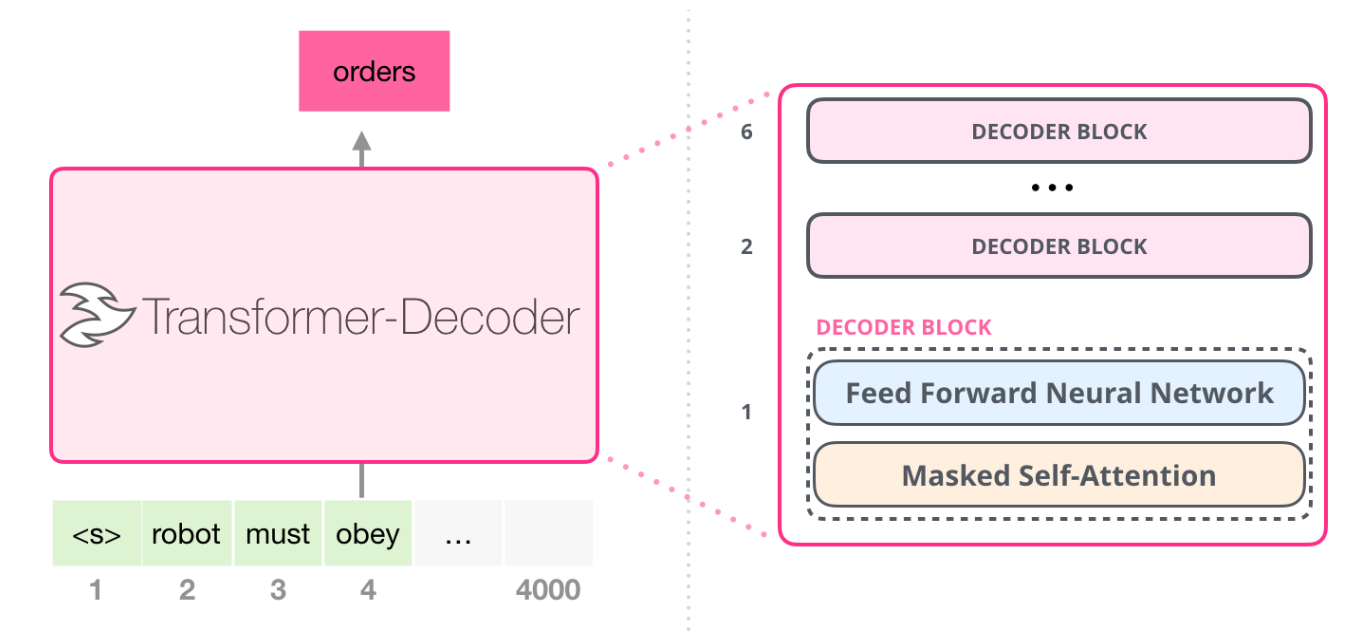
Standard decoder-only transformer. 48 blocks. Each one does masked multi-head self-attention and a GeLU feed-forward network, wrapped in layer norm and residual connections. Pretty standard stuff.
We let Nsight do the talking. Profile, find the bottleneck, fix it, repeat.
The starting point. Single-threaded, slow, but correct. We used this to check our GPU work. (Provided by course staff, based on Karpathy's llm.c).
ground truth
One thread per output, all global memory. It worked, but matmul was eating 97% of the GPU time (243 ms). The profile told us exactly where to start.
matmul 243 ms · 97.4% of GPU time
We hit the GEMM hard. Tiling, shared memory, TF32 tensor cores. We also rewrote layer norm and softmax using warp reductions. Matmul was no longer the main bottleneck.
matmul 10.7 ms · 22.8×
This is where it got fun. FlashAttention-2 kept the attention matrix on-chip. KV-caching made generation actually viable. CUTLASS fused a bunch of FFN steps together. End result: 24.2× faster end-to-end.
full forward 249.8 → 10.3 ms · 24.2×
The forward pass is basically seven main operations. Here's what each one does and where the bottlenecks were.
14 optimizations total. Some were required for the class, some we did just to squeeze out more performance. Expand any row for the details.
Numbers from our Nsight profiles and final report. Run on an NVIDIA A40 (batch 4, seq 64) unless otherwise noted.
For the class speed competition, we just cherry-picked the fastest version of each kernel and slapped them together. comp.sh handles the wiring.
cp kernels_req_1/attention.cuh kernels/
cp kernels_req_1/matmul.cuh kernels/
cp kernels_req_3/layernorm.cuh kernels/
cp kernels_req_3/softmax.cuh kernels/
make test_gpt2 # + op_16 fused GeLU, op_13 aligned activations
sbatch verify.slurm # profile on a Delta A40
comp.sh copies the tensor-core kernels (req_1) and reduction kernels (req_3) into kernels/, while gpt2.cuh folds in the CUTLASS fused-GeLU FFN (op_16) and 256-byte aligned activations (op_13). It builds test_gpt2 and runs verify.slurm on a Delta A40.
Logits OK — max error 0.036, RMSE 0.0012. All tests passed.
The class broke the project into three graded milestones—baseline, required optimizations, then advanced work and the final report.
Built with nvcc and profiled on the NCSA Delta cluster.
make test_gpt2 # forward pass + correctness vs CPU
make test_gpt2_kernels # per-kernel verification
make next_token_generation # autoregressive demo (KV-cache)
sbatch verify_nsys.slurm # profile on Delta